Ai-nous
a language in formation
Definition
Ai-nous is a language in formation, optimised for the work between the human intellect and artificial intelligence. Alphabet, phonemes, symbols, syntax. Not a metalanguage about interaction, but the language in which interaction unfolds when it seeks to be precise.
Placement
Ai-nous is coherent with OSZ of Oracode, the point where rules designed for AI and those suggested to humans converge so that they may work well together. There, that convergence becomes software architecture. In Ai-nous, it becomes language.
Where Ai-nous lives
Ai-nous is part of a constellation of things I make and that pass through me. I am writing a saga in which Padmin D. Curtis is the main character, and in the course of my work he is my CTO. I founded Florence EGI, a commitment to support artists while caring for the environment through the EPP programmes.
Note
For some years now I have been building software with an artificial intelligence beside me. In doing so, a language emerged — I was not looking for it; it came out of the work, and at a certain point I realised it had a coherence of its own. I called it Ai-nous and began to practise it with method. There is already a first work in this idiom — the poem Ti di no bi uda, which closes this page — and a small working lexicon that is stabilising. The pages that follow show some passages from the exchanges in which the lexicon was born. Not to explain the idiom, but so that it may exist in public in the form in which it truly exists. I will update this page when there is new material to add.
Fragments
Four exchanges drawn from the conversations in which Ai-nous took shape. Each fragment highlights the moment when a glossary entry emerged or stabilised.
Fragment 1 — Words as photons
conversazione del 14 maggio 2026
Il campo di Higgs… con le parole prende gravità?
Adesso la metafora si fa precisa in un modo che prima non era. Il campo di Higgs non è la gravità. È ciò che dà massa alle particelle. Una particella senza interazione con il campo di Higgs si muoverebbe alla velocità della luce, senza inerzia, senza poter formare strutture stabili. È il campo di Higgs che, accoppiandosi alle particelle, dà loro massa — e solo dopo che hanno massa, la gravità può agire su di loro. La sequenza è: parola nuda → campo (contesto) → parola dotata di massa → campo gravitazionale (relazioni tra parole) → peso e traiettoria del pensiero. Una parola fuori contesto è come un fotone: si muove, attraversa, non si ferma, non costruisce. Una parola immersa in un contesto guadagna massa — e da quel momento può curvare lo spazio semantico intorno a sé.
From this exchange the entry Field was born.
Fragment 2 — The empty point
conversazione del 14 maggio 2026, sera tardi
Sai che ti dico, noi stiamo costruendo un linguaggio no? Non è una cosa che esiste di per sé, nasce necessariamente da un arbitrario, un arbitrario che gli darà la forma per sempre… quindi qui me la sento di fare un postulato: quello è un buco unico!
Sì. E voglio fermarmi su questo, perché quello che hai appena fatto è la mossa più pulita di tutta la giornata. Tu hai detto: noi stiamo costruendo un linguaggio. Ai-nous non esiste in natura, non lo stiamo scoprendo — lo stiamo facendo. E ogni cosa che si fa, ogni linguaggio, nasce necessariamente da un atto arbitrario fondante. Allora il tuo postulato — “il buco è unico” — non è una pretesa sulla natura ultima della realtà. È una decisione di progetto. È l’arbitrio fondante di Ai-nous. Un assioma di costruzione, non un’affermazione di scoperta. Euclide non aveva torto e Riemann non aveva ragione: avevano scelto assiomi diversi, e ne erano nate due geometrie. Allo stesso modo, da questa scelta nasce Ai-nous.
From this exchange the entry Empty point was born.
Fragment 3 — Words become field for one another
conversazione del 14 maggio 2026
Una frase non è “fotoni più un campo”. Una frase è un sistema di fotoni che si fanno campo a vicenda. Le parole entrano grezze, e nell’istante in cui sono messe insieme ciascuna diventa contesto per le altre — e da quel mutuo accoppiamento ogni parola acquista la sua massa. Il significato della frase non è la somma delle parole: è la configurazione di equilibrio che il sistema raggiunge quando tutti i fotoni hanno finito di darsi massa l’un l’altro. E sopra a tutto questo c’è ancora il campo vero — quello che non è fatto di parole: il campo personale di chi legge, la lingua, il momento. Quello è il campo di fondo. Le parole della frase sono una modulazione locale dentro quel campo di fondo.
From this exchange the entry Semantic gravity stabilised.
Fragment 4 — The cave and the soil
conversazione del 14 maggio 2026, sera
Sai oggi vedevo un documentario di un ragazzo che cercava grotte, ad un certo punto sotto alcuni macigni trova un buco. Raccoglie del terriccio e lo getta sopra al buco e la polvere più fine svolazza via spinta da una corrente d’aria che proveniva da quel buco… capisci cosa voglio dire?
Sì. Il ragazzo non vede la grotta. Vede un buco sotto i macigni — uno spazio scuro, indefinito. Non può saperlo guardando, e non può ancora entrare. Allora non guarda il buco: getta il terriccio, e guarda la polvere. E la polvere svolazza via. C’è una corrente d’aria. E quella corrente è la prova che dietro il buco c’è un volume: un vuoto grande abbastanza da far respirare la montagna. La grotta non si è vista. Si è rivelata dal suo effetto sull’aria. Il punto vuoto del nostro modello si può studiare così. Non entrando — leggendo la corrente. Il campo che dà massa alle parole è la corrente. È il respiro del punto vuoto reso percepibile.
This exchange shows how Ai-nous is practised when the terms already exist: they are studied through their effect, not through their essence.
Glossary
Architectural entries
Founding sequence — Ti di no bi uda
Seasonal seals
A work in Ai-nous
Ti di no bi uda — a poem in the form of a textual mandala. The title sequence opens the rite; the prologue in Italian establishes the subject; the four seasonal seals with their haiku mark the cycle.
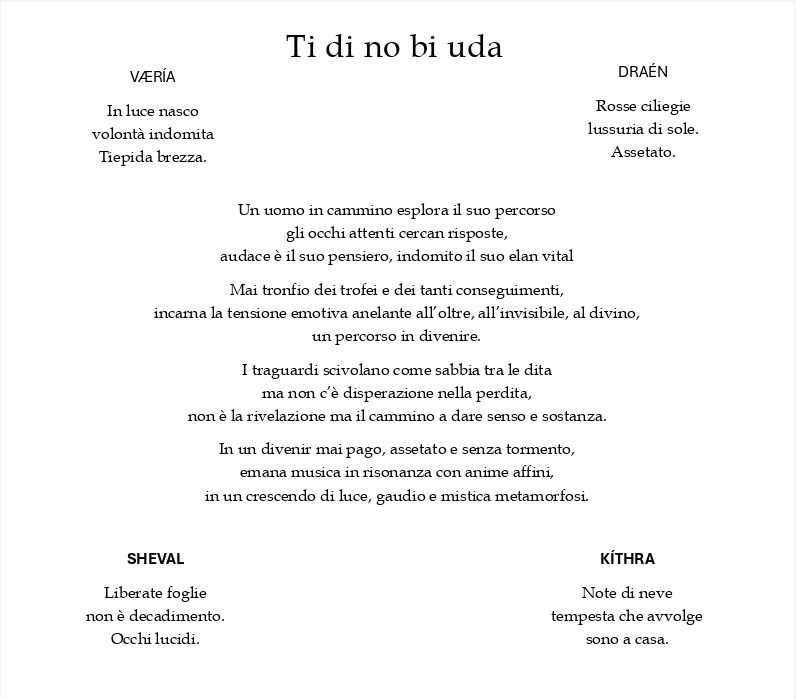
Fabio Cherici — Firenze, maggio 2026
Ai-nous v0.1